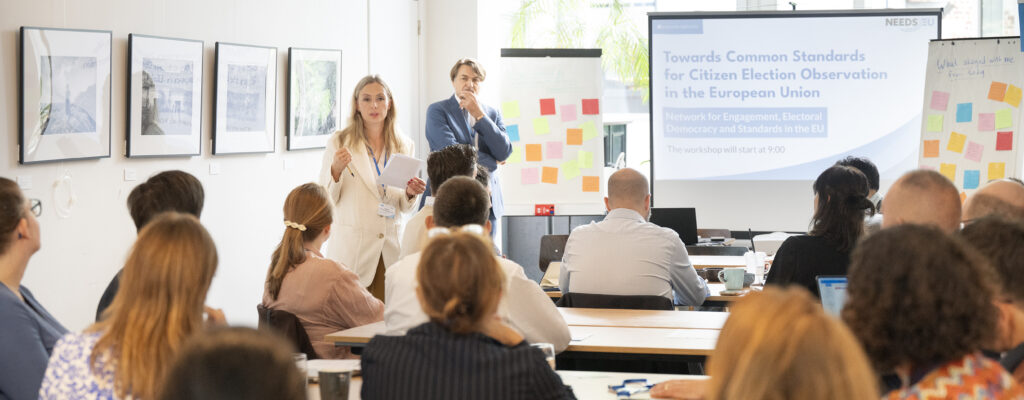
NEEDS-EU In-Person Workshop — Towards Common Standards for Citizen Election Observation in the European Union
Brussels, 5 June 2026. From 3 to 5 June, Election-Watch.EU organised an in-person workshop under the NEEDS-EU project, bringing together civil society representatives, experts, practitioners, and researchers for three days of intense dialogue and learning.
The event offered a platform for dialogue and exchange, with participants from 21 EU Member States gathered in Brussels to share lessons learnt and develop common standards for election observation across the European Union through concrete cases and national experiences.
Election observation across the EU
Sessions spanned citizen election observation, observer accreditation, electoral reform advocacy, and digital electoral integrity. The intersection of agendas in electoral processes — from digital regulation and democratic resilience to inclusion and transparency – clearly emerged from the discussions.
The challenges posed by the digital sphere represented a core theme, with conversations covering transparency and accountability measures against FIMI and a human-rights-based approach to the regulation of digital spaces. Particular importance was placed also on inclusion and accessibility measures in electoral processes, including women’s participation in politics and access and accommodation for persons with disabilities, with input from the European Disability Forum.
Thanks to interventions by representatives of EU institutions, the workshop provided a space to engage directly with European decision makers and bridge the gap between citizen election observation and the European policy making processes. Exchanges addressed the European Democracy Shield and EU Digital Regulations, like the Transparency and Targeting of Political Advertising (TTPA) Regulation, and the AI Act. Representatives from the European Commission’s Directorate-General for Justice and Consumers (DG JUST) outlined in more depth the upcoming Centre for Democratic Resilience and TTPA implementation, while MEP Michael McNamara provided insights in the role of the European Parliament in electoral reform advocacy and the Omnibus bill to simplify the AI Act.
Outcomes and key takeaways
The interactive sessions helped develop an approach for translating election assessment findings and recommendations into actionable advocacy strategies, and practical steps to guide the NEEDS-EU network’s long-term engagement for sustainable reform processes, particularly ahead of the 2029 European Parliament elections. The workshop advanced these goals by:
- Stressing that the advancement of electoral reforms is contingent on both EU and national level recognition and facilitation of work of election observers and on proactive policy input and advocacy by observers and active citizens themselves.
- Identifying a number of Member States where the proposed Model Election Observer Accreditation Procedures could serve as a practical entry point for reform and highlighted the importance of building a coalition of practitioners, civil society organisations and institutional actors to advance common European standards.
- Outlining pathways for translating election observation findings into sustainable electoral reform through strategic partnerships, evidence-based advocacy, and long-term stakeholder engagement.
- Agreeing that election observation methodologies, advocacy strategies, and EU regulatory frameworks must evolve to address emerging risks like the increasing use of AI in election campaigning, FIMI, and quantum computing, ahead of the 2029 European Parliament elections.
- Underscoring that comprehensive electoral reforms at EU and Member State levels need to continue to prioritize further regulatory and practical steps to safeguard inclusion and accessibility for vulnerable and underrepresented groups.
By gathering practitioners and institutional actors, the workshop successfully moved from assessment and recommendations towards sustained stakeholder engagement for evidence-based reform advocacy, both at the EU and national levels, in line with the objectives of the NEEDS-EU project.
citizen election observation, election observation, European elections, NEEDS EU, observer accreditation
 Election-Watch.EU launches the Model Framework for Election Observer Accreditation Procedures
 Exchange with MEP Juan Fernando López Aguilar on the future of European electoral reform
 Dr. Beata Martin-Rozumiłowicz joins Election-Watch.EU’s Advisory Board
 European Commission High-Level Event on Democracy