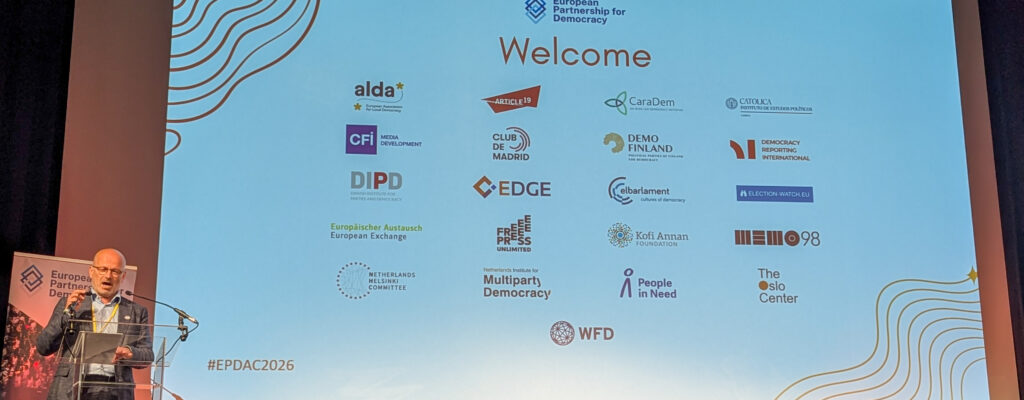
Election-Watch.EU at the EPD Annual Conference 2026: Designing Democratic Resilience
On 8-9 June 2026, Election-Watch.EU participated in the European Partnership for Democracy (EPD) Annual Conference in Brussels and the Youth Democracy Cohort (Un)Conference. The events brought together democracy practitioners, civil society organisations, policymakers, researchers, youth activists, and representatives of EPD’s 21 member organisations to reflect on one central question: how can democracies remain resilient in times of growing political, social, and technological disruption?
It was a valuable opportunity to exchange experiences with colleagues from across the EPD network, discuss innovative approaches to democracy support, learn from good practices, and explore alternative funding models for civil society and democratic participation.
Youth, Democratic Delivery and the Window of Opportunity
The Youth Democracy Cohort (Un)Conference on 8 June focused on meaningful youth participation and democratic renewal. A recurring theme throughout the discussions was that young people are no longer primarily asking whether democracy exists, but whether democracy delivers.
Participants reflected on recent youth-led mobilisation movements across the world and the risks that arise when democratic actors fail to respond quickly enough. Several examples illustrated how windows of opportunity can close rapidly and how grassroots mobilisation can be captured or co-opted by established political actors if democratic reformers are not sufficiently organised and prepared.
The discussions also explored ways to strengthen youth representation, including innovative approaches that link public funding for political parties to the representation of women, young people, and persons with disabilities.
Designing Democratic Resilience
The EPD Annual Conference examined democratic resilience from multiple perspectives. A key takeaway was that resilience should not be understood solely as institutional preparedness or crisis management capacity. Instead, democratic resilience ultimately depends on public trust, democratic credibility, and citizens’ belief that democratic systems can effectively respond to societal challenges.
Speakers stressed that democracy support organisations should not see themselves merely as explainers of democracy, but as conveners capable of bringing together different parts of society to collectively discuss how resilience can be built and maintained.
Particularly interesting examples included Ireland’s whole-of-society approach to cybersecurity and societal preparedness, sometimes described as a form of “social fence” or “total defence”, where democratic resilience is considered a shared societal responsibility rather than solely a governmental function.
Reimagining Democratic Digital Spaces
Another important discussion focused on the future of digital public spaces.Participants highlighted the need to move beyond a model dominated by a small number of very large online platforms. Rather than seeking European equivalents of existing Very Large Online Platforms, discussions emphasised the importance of supporting ethical technologies, community-run platforms, open-source ecosystems, and alternative digital infrastructures.
Examples such as Mastodon and the broader open-data movement illustrated how democratic digital spaces can be built around community ownership, transparency, and public interest rather than purely commercial incentives. Several participants argued that online infrastructure should increasingly be viewed as a form of public infrastructure, comparable to how societies build and maintain cities.
Rebuilding Trust Through Positive Democratic Agendas
A strong message throughout the conference was that a critical mass of citizens no longer trusts that democratic systems can deliver tangible improvements to their lives. Speakers stressed that democracy actors must move beyond defensive approaches and develop positive democratic agendas capable of responding to citizens’ concerns and aspirations.
Civil society organisations were repeatedly described as an essential part of democratic infrastructure. While public institutions have an important role to play in safeguarding democratic standards, maintaining democratic resilience requires active and independent civil society engagement.
In this context, the Cabinet of European Commissioner Michael McGrath highlighted the establishment of the new Centre for Democratic Resilience, bringing together all 27 EU Member States to strengthen democratic preparedness and cooperation. Discussions also touched upon ongoing European Commission initiatives, including work on recommendations concerning the safety of politicians and candidates, to which Election-Watch.EU has contributed through recent consultations.
centre for democratic resilience, Civil Society, democracy, youth participation
 Election-Watch.EU launches the Model Framework for Election Observer Accreditation Procedures
 Exchange with MEP Juan Fernando López Aguilar on the future of European electoral reform
 Dr. Beata Martin-Rozumiłowicz joins Election-Watch.EU’s Advisory Board
 European Commission High-Level Event on Democracy