

On the International Fact-Checking Day, Election-Watch.EU recognises the essential role of fact-checkers in safeguarding democratic discourse and processes. Yet, in today’s complex information environment, fact-checking alone is no longer sufficient.
Disinformation, and more broadly Foreign Information Manipulation and Interference (FIMI), operates across platforms, borders, and narratives. It evolves rapidly, often exploiting moments of political sensitivity such as elections. Protecting electoral integrity therefore requires a systemic approach: combining monitoring, analysis, fact-checking, and coordinated response.
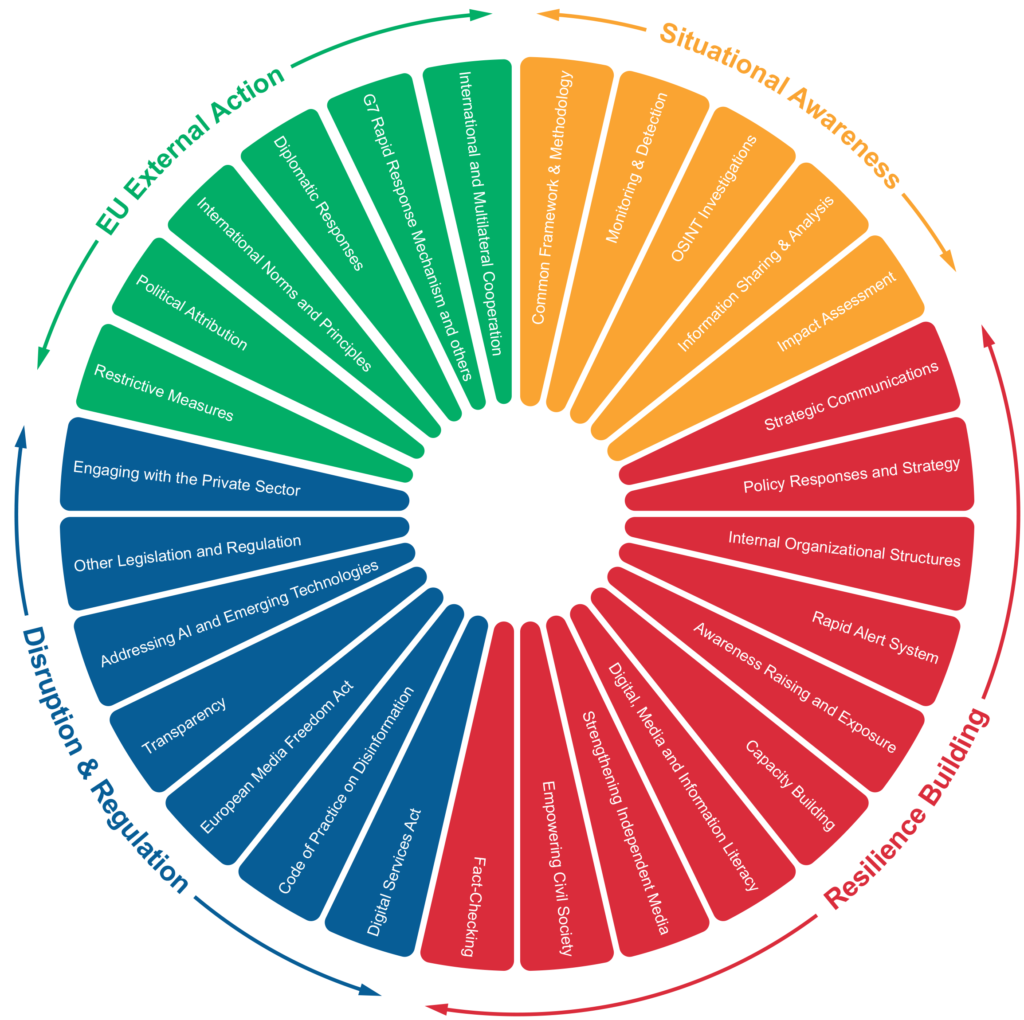
Across the European Union, efforts to counter FIMI, led by the European External Action Service (EEAS), are increasingly structured around a comprehensive response ecosystem, linking situational awareness, analysis and risk assessment, strategic communication and response, regulatory and policy frameworks, resilience-building, and public engagement.
For an effective response to FIMI, these elements interact, forming a continuous cycle from early detection to long-term democratic resilience. This approach recognises that disinformation is not only a content issue, but a systemic challenge affecting democratic processes, fundamental rights, and public trust.
Elections are particularly vulnerable to information manipulation. FIMI operations can undermine trust in electoral processes and institutions, distorting public debate and voter perceptions. At the same time, FIMI targets specific groups, including minorities, diaspora communities, and political candidates, suppressing participation and amplifying polarisation.
Importantly, these dynamics often unfold in hybrid online environments, where mainstream platforms interact with less regulated spaces.
Effective responses start with robust, evidence-based monitoring. Recent analytical work, including Election-Watch.EU’s engagement in social media monitoring during electoral processes, shows that disinformation narratives can spread organically and rapidly, without coordinated campaigns.
Moreover, messaging platforms such as Telegram can act as amplifiers outside traditional moderation structures, and toxic and polarising content often outperforms neutral information in terms of visibility and engagement.
These dynamics highlight the importance of early detection of narratives, mapping of information ecosystems and channels, as well as understanding how content spreads and resonates.
Fact-checking remains a core pillar of democratic resilience, but its impact depends on how well it is integrated into a broader framework. In effective systems, fact-checking:
To be effective, fact-checking must move from reactive debunking to proactive ecosystem engagement.
Election-Watch.EU contributes to this European approach as a member of the RESONANT Stakeholder Board, a strategic initiative addressing FIMI and information suppression. Within RESONANT, the focus is on:
This work directly supports efforts to strengthen electoral integrity, protect fundamental rights and freedoms, and enhance coordination across EU and national stakeholders.
Ultimately, countering disinformation in elections is not only about correcting falsehoods: it is about strengthening the resilience of democratic systems as a whole.
This includes empowering citizens and civil society, supporting independent media and fact-checkers, improving platform accountability and transparency, and enhancing institutional preparedness and coordination.
Fact-checking is indispensable, but it is most effective when embedded in a structured, coordinated, and evidence-based response system. Safeguarding elections today requires moving beyond isolated interventions and towards a holistic approach that connects monitoring, analysis, policy, and public engagement, for democratic societies to effectively respond to the evolving challenges of disinformation and FIMI.
 Election-Watch.EU launches the Model Framework for Election Observer Accreditation Procedures
 Exchange with MEP Juan Fernando López Aguilar on the future of European electoral reform
 Dr. Beata Martin-Rozumiłowicz joins Election-Watch.EU’s Advisory Board
 European Commission High-Level Event on Democracy